About Kurukshetra University


www.kuk.ac.in

Kurukshetra University, established in 1957, has a well-developed multi-faculty Campus spread over 473 acres of land on the south bank of Brahmsarovar.
Ever since laying of foundation stone by Dr. Rajendra Prasad, the First President of India, the University has taken quantum leaps and has emerged as an advanced centre of Study & Research for quality education in conformity with the international standards. The University has centrally air- conditioned auditorium with a seating capacity of 2500 and 70mm projector, Senate Hall, Conference Hall, well-equipped Sports Complex (Play fields, Gymnasium, Stadium, Swimming Pool, Tennis Courts, Volleyball, Basketball Courts, etc.), Teachers' Club, Club for Administrative staff, 25 Hostels, (11 for Boys & 13 for Girls and 1 for Foreign male students), School, Health Centre, Business Complex, about 700 quarters for all categories of staff. Kurukshetra University has a rich Jawaharlal Nehru Library with more than 3.80 lac books, 181 journals (Foreign & Indian) and 15,328 rare manuscripts, Internet Section of 200 nodes, Computer Centre, Museum, Instrumentation (USIC) workshop, NSS Centre, Students' Guest House, Faculty House, etc. In addition to Directorate of Distance Education, University College and University College of Education, the University has 45 Teaching Departments on the campus and 369 affiliated colleges situated in the Districts of Ambala, Panipat, Kaithal, Yamuna Nagar, Hisar, Jind, Karnal, Kurukshetra and Panchkula.


Organizing Departments of KUK


B. R. GULZARI LAL NANDA CENTRE OF ETHICS, PHILOSOPHY, MUSEUM AND LIBRARY

Gulzari Lal Nanda ji’s last wish was that his ashes be kept in Kurukshetra itself. As per his wish, after his death, his ashes were buried in Gulzari Lal Nanda Memorial. Under the aegis of Kurukshetra Development Board, the foundation stone of Gulzari Lal Nanda Memorial was laid by the then Prime Minister Atal Bihari Vajpayee on 4 July 1999 in the presence of Union Home Minister Lal Krishna Advani, Human Resource Minister Dr. Murli Manohar Joshi, Haryana Chief Minister Chaudhary Bansi Lal and His Excellency Governor Mahavir Prasad Ji. Gulzari Lal Nanda National Unity and Peace Institute was inaugurated by His Excellency Governor of Haryana Dr. A.R. Kidwai on 4 July 2006. Kurukshetra University took this institute on a lease of 30 years on 9 February 2010. Vice Chancellor of Kurukshetra University, Lt. Gen. Dr. D.D.S. Sandhu decided to spread the ideology of Gulzari Lal Nanda ji to the masses and started a new institute in Kurukshetra. This memorial has been named as Sh. Gulzari Lal Nanda Centre of Ethics, Philosophy, Museum and Library by Kurukshetra University. Under the aegis of this centre, many programmes are organised throughout the year to spread his Gandhian ideology to the common people through educational activities in collaboration with Social and religious organizations.


UNIVERSITY SCHOOL OF MANAGEMENT
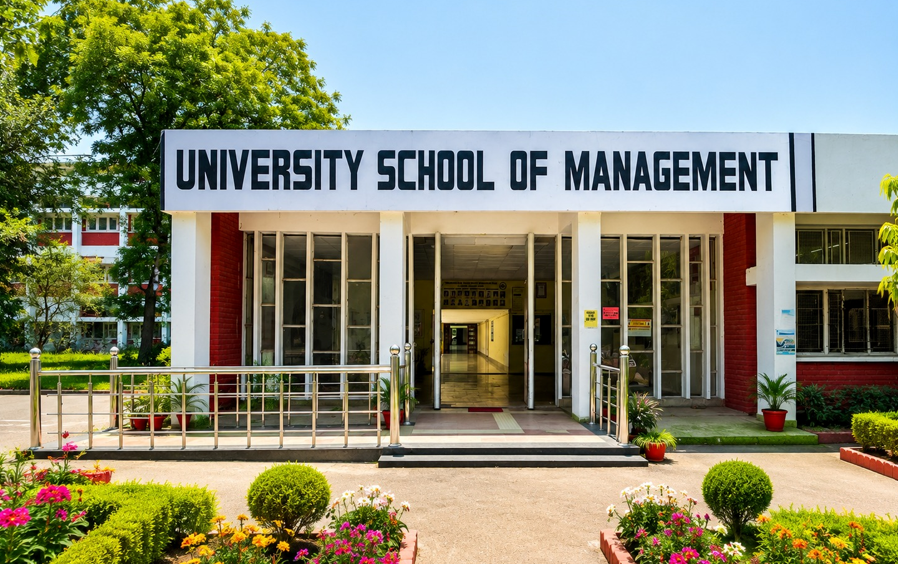
Established in 1973, the University School of Management (USM), formerly known as the Department of Management, is one of the oldest and most reputed management institutions in North India. Since its inception, the School has remained committed to academic excellence, value-based education, innovation and industry relevance. Over the decades, USM has built a strong reputation for producing competent managers, entrepreneurs, researchers and academicians. The School offers a two-year full-time MBA programme with an annual intake of 240 students (120 Budgeted and 120 Self-Financing Scheme) along with a vibrant Ph.D. programme in Management. The curriculum is continuously updated in accordance with NEP-2020, Outcome-Based Education (OBE), industry expectations and emerging global business practices. Teaching-learning at USM combines classroom instruction with case studies, simulations, live projects, internships, industrial visits, expert lectures, research assignments and digital learning tools. Students are encouraged to develop analytical thinking, communication skills, ethical values, leadership qualities and entrepreneurial mindset. The School offers specializations in Marketing, Finance, Human Resource Management, Business Analytics, Entrepreneurship Development, and International Business. The department maintains close interaction with industry through internships, placement drives, guest lectures, alumni engagement and collaborative activities.


DEPARTMENT OF TOURISM & HOTAL MANAGEMENT
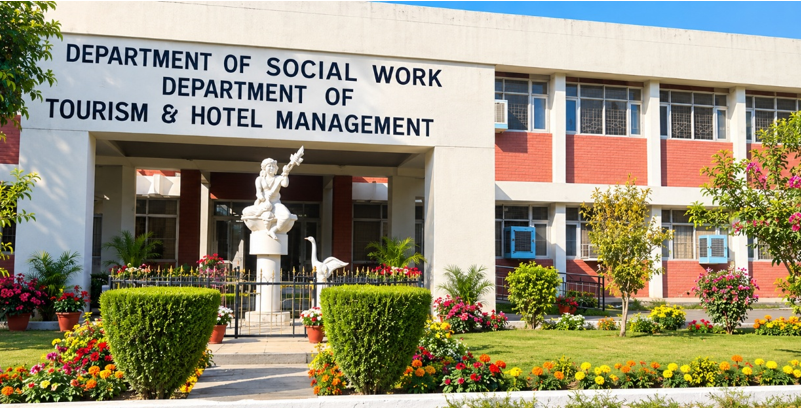
The Department of Tourism and Hotel Management, Kurukshetra University, Kurukshetra—an A++ Grade NAAC-accredited university—was established in 1989 under the Faculty of Commerce and Management. It holds the distinction of introducing India’s first master’s degree programme in Tourism.
The Department currently offers the Master of Tourism and Travel Management (MTTM), Master of Hotel Management and Catering Technology (MHM&CT), Bachelor of Hotel Management and Catering Technology (BHM&CT), and Bachelor of Management Studies in Event Management under AEDP. The MHM&CT and BHM&CT programmes were introduced in 2002 and 2009, respectively, while the Event Management programme commenced in 2025. The Department also offers a Ph.D. programme in Tourism and Hotel Management.
Over the years, the Department has emerged as a pioneer in tourism, hospitality and event-management education. Its experienced and multidisciplinary faculty is committed to developing the Department as a Centre of Excellence in accordance with international academic and professional standards.
The curriculum is contemporary, industry-oriented and aligned with the National Education Policy (NEP) 2020. It is regularly updated through interaction with academicians, industry professionals, alumni and students to meet the evolving needs of the tourism and hospitality sectors.
The Department follows a balanced approach combining theoretical knowledge, practical exposure, skill development and innovative teaching methods. It aims to develop competent professionals, responsible leaders and successful entrepreneurs who can adapt to the changing business environment while remaining sensitive to ethical, social, cultural and environmental responsibilities.


CENTRE OF EXCELLENCE FOR RESEARCH ON THE SARASWATI RIVER (CERSR)

The Centre of Excellence for Research on the Saraswati River (CERSR), established at Kurukshetra University and funded by the Haryana Sarasvati Heritage & Development Board (HSHDB), is executing a multidisciplinary project titled "Geoscientific multidisciplinary exploration of the Saraswati River System basin Civilization and its heritage" under the leadership of Prof. Dr. A. R. Chaudhri. The Centre serves as India's nodal resource point to scientifically validate the Vedic grandeur, chronological evolution, and spatial expanse of the Saraswati River system using state-of-the-art remote sensing, geological mapping, and absolute dating techniques ( 14C and OSL).
Key Scientific & Field Activities Undertaken: The Centre has transformed the exploration of the Saraswati basin from traditional linear mapping into an expansive, network-driven ground analysis: Advanced Remote Sensing Analysis: Utilizing Indian Remote Sensing series, Google Earth Landsat 8, and NASA Shuttle Radar Topography Mission (SRTM) data via ERDAS Imagine and ESRI ArcGIS, the CERSR has mapped a dense, interconnected web of stream channels, terraces, and deltaic deposits; Expanse Mapping: Successfully delineated a massive network of interconnected channels measuring more than 3,290 km traversing nearly all 22 districts of Haryana; Extensive Stratigraphic Trenching: Conducted deep trenching operations (ranging from 2 to 10 meters) across pivotal sites like Bohli (Ladwa), Macheri (Ishargarh), Sugh (Yamunanagar), Ganjbar (Panipat), Anupgarh (Rajasthan) to log sediment variations and document fluviatile structures (cross-bedding and laminations) derived from higher Himalayan crystalline rocks; Geo-Archaeological Validations: Carried out field exploration and geological sampling at globally renowned Harappan and historical settlements including Rakhigarhi (Hisar), Mitathal (Bhiwani), Thana (Kaithal), and Dhosi Hill (Mahendargarh); Major Achievements & Strategic Breakthroughs Debunking the 5,000-Year Extinction Narrative: A landmark international publication by the CERSR in the peer-reviewed SCI journal Archaeological Prospection proved that the Saraswati River system did not dry up 5,000 years ago but was fully active and flowing through Haryana until 1402 AD. The abrupt cessation post-1402 AD is linked to massive anthropogenic rerouting of foothill channels to build historical canal networks (like the Western Yamuna Canal); Mapping the Vedic Grandeur (Sapt Sindhu & Floodplains): Field surveys proved that individual paleochannel floodplains reach an immense width of 1.62 km to 3.20 km in Yamunanagar, expanding up to 8.74 km at Sirsa and 13 km in Hisar, matching the text of the Rig Veda. Furthermore, the Centre successfully located the "Sapt Sindhu" (seven contributing Vedic streams) in Kurukshetra; Geospatial Demarcation of "Brahmavarta": By analyzing ancient texts (Manu Smriti) alongside the mapped confluence lines of the ancient Saraswati and Drishadvati rivers, the CERSR generated the first scientifically accurate geographical boundaries of the sacred land Brahmavarta; Unearthing Historical Infrastructure (Sangmeshwar Ghat): In collaboration with the HSHDB at Dhanipura village (Pehowa), excavated a 12-tiered, ancient buried bathing ghat built with thin baked bricks and lime mortar, verifying the accounts detailed in the Shri Vaman Puran; Kushan Period Continuity Proofs: Recovered archeological structures and diagnostic finger-imprinted Kushan-era bricks at Thana (Kaithal) and Nindana (Rohtak), demonstrating continuous river flow and active civilizational utilization up to the 1st–3rd Century AD; Discovery of Westward Migration Mechanism: Proved that tectonic modifications, continuous northward movement of the Indian plate, and sub-surface fault activations caused the river to shift gradually westward from its original eastern trunk (the Kailash-Mansarovar sourced ancient Drishadvati channel) to the Adi Badri-Yamunanagar alignment. The Saraswati River primary data research results have been presented in the book entitled `The Saraswati River Gatha’ which can be accessed at https://heyzine.com/flip-book/f80edff785.html


DEPARTMENT OF LAW

The Law Department was established in 1969 as the first Law Department in the State of Haryana to impart legal education and to conduct original and fundamental research in the contemporary areas of law and allied subjects. Since its inception, very renowned, eminent and outstanding scholars have headed the Department.
The Department offers courses, namely LL.B., LL.M. and Ph.D. A sustainable number of students of the department have been qualified the JRF, NET, and SLET tests and also have been selected and elevated to teaching, higher judicial and administrative services. Some of the publications produced by the members of the teaching faculty have won national as well as international appreciation. Besides this the Department has organized a number of Seminars on important themes particularly on contemporary areas of law. Visiting fellows are invited from different Universities for special & guest lectures from time to time. The prime objective of the department is to achieve academic excellence in research and to inculcate & promote the legal education. The department has achieved the place as a centre of national & international legal research and studies, in which the students, lawyers, judges, government officials and academicians have been participating.